
Drawing Transitions
Check out the Xtreme Skater Ramp Tool for calculating the transition cuts.
The String and Compass method can be used to draw smooth and precise transitions.
Here's how it works, when cutting a transition, the curve always follows that of a perfect circle (unless you want an irregular ramp). So, to draw the transition, you just need to figure out how large of a radius you want for your curve and where to start/end the transition. These factors will depend on the ramp you are building.
The following is directions for cutting the transition for a 3 feet and 6 inches tall halfpipe, using a transition radius of 6' 10", see the bottom of the page for how the transition differs for other ramps.
Watch The Video
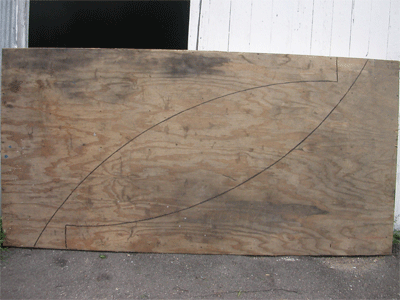
A couple of notes on this video: I used a platform instead of just a 4x8 sheet of plywood so that I could stand it vertical for the video, when you are drawing the transition you can just lay the plywood flat on the ground. I draw the transition twice to demonstrate that you can cut two sides from one sheet of plywood. When you are making a ramp, you should only draw the transition once, then cut out the piece and use it to trace the rest of the transitions.
Step 1: Attach a 2x6
First, draw a line (or just two points), that go along the width of the plywood that are 18" into the plywood.
Next, attach a 2x6 (or a 2x4 or just anything that is at least 7' and straight) to the (3/4)" sheet of plywood. Use the line you drew to make sure the 2x6 is completely vertical.
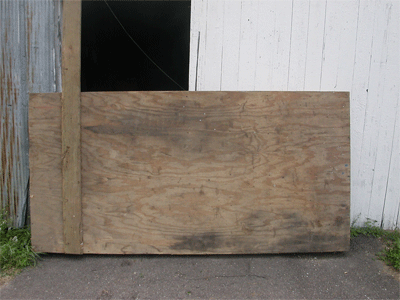
Again, the 2x6 goes 18" into the plywood, which was pre-calculated so that two cuts could be made from one sheet of plywood.
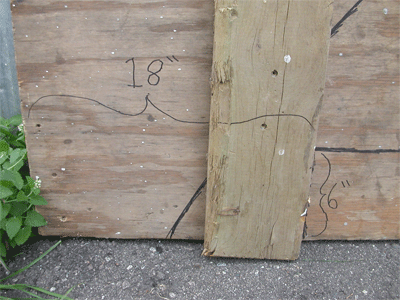
NOTE: In the picture above where it says 6" it should day 5.5", I forgot that 2x6's were actually only 1.5" by 5.5".
Step 2: Attach the Pencil
Next, draw a point along the 2x6 that is 5.5" off the ground (marked incorrectly as 6" in picture above). You will start the transition 5.5" off the ground because for this halfpipe there will be a flatbottom that is 5.5" high.
Now measure 6' 10" along the 2x6 from the point you just drew and put a screw into the side of the 2x6 there, attach a string to the screw. Here I use fishing wire (2 lb test line), Any string with minimal give/stretch will work.
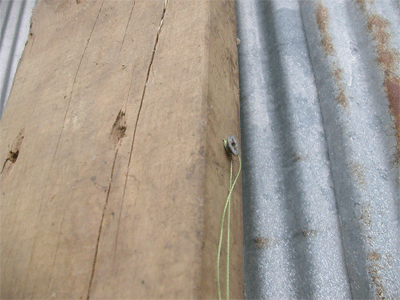
At the other end of the string connect a pencil (I use a marker for video purposes only). Take your time doing this so that the pencil is lined up with the point you made 5.5" off the ground.
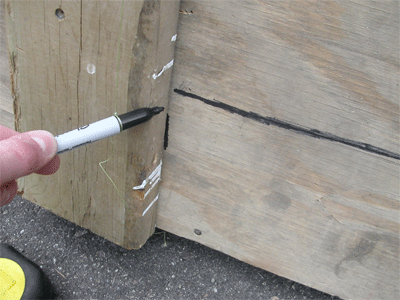
Step 3: Draw the Transition
Now the String and Pencil does the work for you. VERY SLOWLY draw the transition, trying your best to keep a constant amount of tension on the string and keeping the pencil at a 90 degree angle with the plywood.
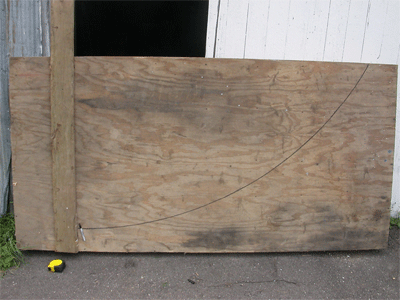
You are just about done, if you haven't already, draw a line from your point 5.5" off the ground to the ground, Then use a jig saw to cut the transition you have drawn. Use the piece you cut out to trace the second rather than drawing both using this method.
Transitions for Other Ramps
So now you should know exactly how to draw the transition if you were to make a 3'6" high halfpipe with a 6" flatbottom, some tips for the other ramps on this site...
- 4' Quarterpipe: The quarterpipe transitions to the ground, so you start the transition from the ground instead of 6" up. Since you are starting from the ground you can afford to start less than 18" into the plywood and still fit two sides in each piece of plywood, this way the sides will have a larger flat top on them.
- 8' Halfpipe: In the plans I show a picture of how to align two pieces of plywood needed for each side of the ramp, use those measurements. Drawing the transition for this is more difficult because you have to use two pieces of plywood, I would recommend finding other resources to help you with this. Maybe someday it will be covered on this site.
- Funbox: Like the quarterpipe you will be starting from the ground instead of 6", It should be pretty easy to fit 4 sides out of a piece of plywood so just draw the transition in a way that allows them all to fit. Since the funbox is 2' high and the plywood is 4' wide, you need to measure your stopping point (another way is to cut the plywood in half the long way (hot dog way), then make two pieces out of each half). As I mention in the plans a 6' 10" transition works well.